
Technical insight
Impeller Blade Edge Break Approval Before Finishing
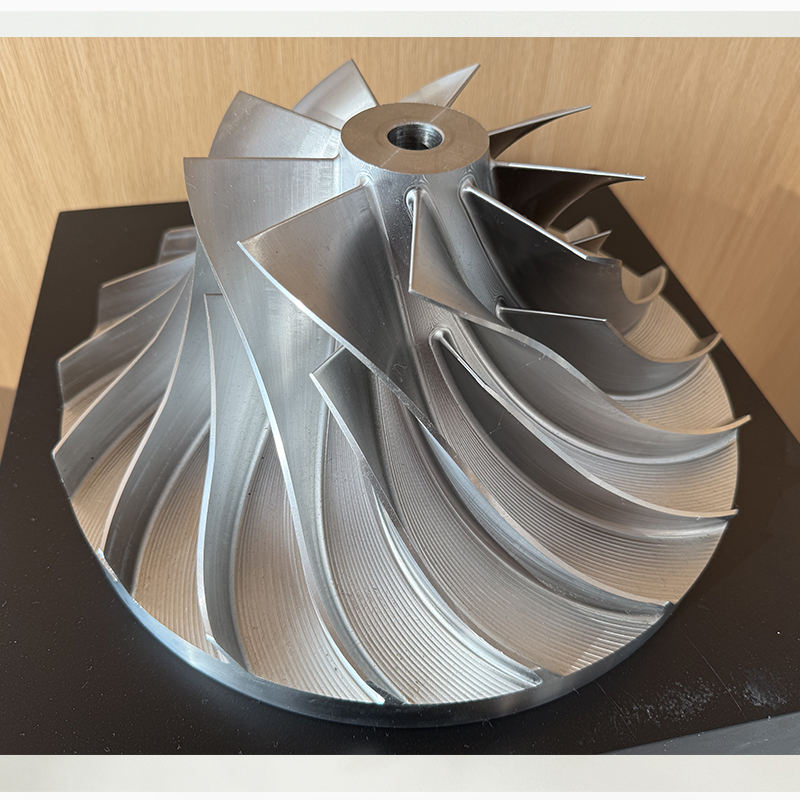
Before accepting a proposal to soften an impeller blade edge, ask where material may be removed and which released surfaces must remain unchanged. Mark the affected edge segments and obtain the design authority’s approval before the finishing handoff. Keep a general burr-removal instruction separate from permission to alter a defined blade profile, and agree the evidence needed after the approved operation.
By Geetai Precision
- Published
- Updated
Defined profiles and undefined edges
ISO 13715:2017 covers the indication and dimensioning of edges whose shape is undefined. Its public abstract directs geometrically defined edge shapes to ISO 129-1. [1]
For an edge already defined by the released blade geometry, request design-authority approval for a proposed edge break that changes that definition. Use the cited distinction as a review question; it supplies no rounding allowance or permission to change the part. Ask the drawing owner to resolve a conflict between a general edge note and a local blade definition.
Identify the leading edge, trailing edge and blade-tip corners from the actual drawing and model. Ask the design owner to name the controlled edge form and adjacent faces. Keep blade-root fillet changes and surface-texture requirements in their own reviews; an approval for one of those subjects should not silently authorize perimeter removal.
A blade-edge permission map
Request one marked map for the proposed finishing operation. Include blade identifiers, segment endpoints, local section references and surfaces excluded from removal. Use this original worksheet with the design authority; its entries are purchasing prompts, not standard-defined edge limits.
| Edge location | Approval request | Release checkpoint |
|---|---|---|
| Leading or trailing edge with a defined profile | Mark the proposed removal boundary and the neighboring blade-face region on the controlled model. | Obtain approval of the final edge definition before releasing the affected finishing step. |
| Blade-tip corner joining two edge segments | Ask whether each edge instruction continues around the corner or ends at an identified point. | Hold the corner treatment until its transition and final checking requirement receive approval. |
| Local segment governed by an undefined-edge note | Identify the exact note and segment; keep its extent separate from a geometrically defined blade edge. | Return conflicting local and general instructions to the drawing owner before processing. |
| Segment outside the proposed checking access | Identify the inaccessible region and request a proposed way to assess the required final condition. | Keep the affected release open until the technical reviewer approves the method or a documented disposition. |
Ask for a local before-and-after overlay where the proposal changes the nominal shape. Include both sides of the edge and its connection to the next segment. Avoid approving a single global instruction such as “round all edges” while the actual permitted boundary remains unresolved.
Manufacturing and inspection handoff
- Before route acceptance, retain the released geometry and identify the proposed edge map separately. Ask manufacturing to state the intended operation and the design authority to approve the removal boundary, protected regions and affected item list.
- Before finishing, reconcile the approved map with the drawing, model and work instruction. Confirm the current part state and the person authorized to release the step. If the proposal exceeds the approved boundary, pause that operation for disposition.
- After finishing, assess the specified edge and adjacent profile requirements at the agreed final stage. Ask the inspection reviewer to identify the relevant locations, method and report references; do not close the edge item using an unrelated blade-face result.
- Before shipment, link the identified part, approval reference, edge-map revision and required results. Preserve any reported discrepancy and obtain its disposition before further blending or dispatch. Record which later operations require another check.
Evidence for the finished edge
Renishaw’s MODUS airfoil-analysis page lists leading- and trailing-edge radii, angles and thicknesses among analyzed characteristics, using nominal CAD sections and actual sections. This describes that product’s functions, rather than an inspection prescription for this impeller. [2]
Ask the responsible reviewer which of the drawing’s edge characteristics need evidence and how the proposed method addresses them. Where an annotated photograph is requested for location or appearance, identify that purpose separately from dimensional assessment. Resolve an unassessed endpoint or corner explicitly instead of assuming that a result from the middle of an edge covers it.
For example, consider a hypothetical drawing with a defined trailing-edge section and a general burr-removal note. A finisher proposes smoothing the whole blade perimeter. Request a marked proposal showing the trailing edge, tip corner and adjacent faces. If only one segment receives approval, carry that exact extent into the instruction and keep the remaining proposal open. A visually smoother edge should not be the approval criterion unless the released requirement expressly makes it one.
Drawing-led inquiry
For a rotor machining review, provide the released drawing and model, proposed edge map, quantity and unresolved approval questions. State which decisions already have design-authority approval and which require clarification. Use the inspection coordination route to agree the final records, then request a quotation against the same approved package.
Inspection scope and documentation are defined during quotation according to drawing requirements and application needs.
Geetai coordinates drawing-led manufacturing through long-term partners without presenting partner facilities as Geetai-owned.
Keep approval of the finished component separate from approval for an operating pump. Have the responsible design authority define any required engineering evaluation; this worksheet chooses no edge size, finishing recipe or application acceptance limit.
Related review paths
More from Blog
References
- ISO 13715:2017 — Edges of undefined shape — ISO. Accessed 2026-11-04T01:36:05.116Z.
- Airfoil analysis — MODUS airfoil analysis — Renishaw. Accessed 2026-11-04T01:36:05.116Z.