Technical insight
Turbomolecular Pump Rotor Machining: 5-Axis Manufacturing Challenges
For a custom turbomolecular pump rotor, review the proposed manufacturing route—not just the finished appearance. Use this guide to question tool access, support during blade machining and the evidence required before accepting a component. Start with the controlled drawing and model, then agree how the critical features will be produced and checked.
By Geetai Precision
- Published
- Updated
Start with the geometry, not the photograph
Fraunhofer IST explains turbomolecular pumping in terms of moving rotor surfaces acting between stationary stages to transfer momentum to gas particles. Its description provides context for the repeated blade rows; it does not establish the function or suitability of a photographed component. [1]
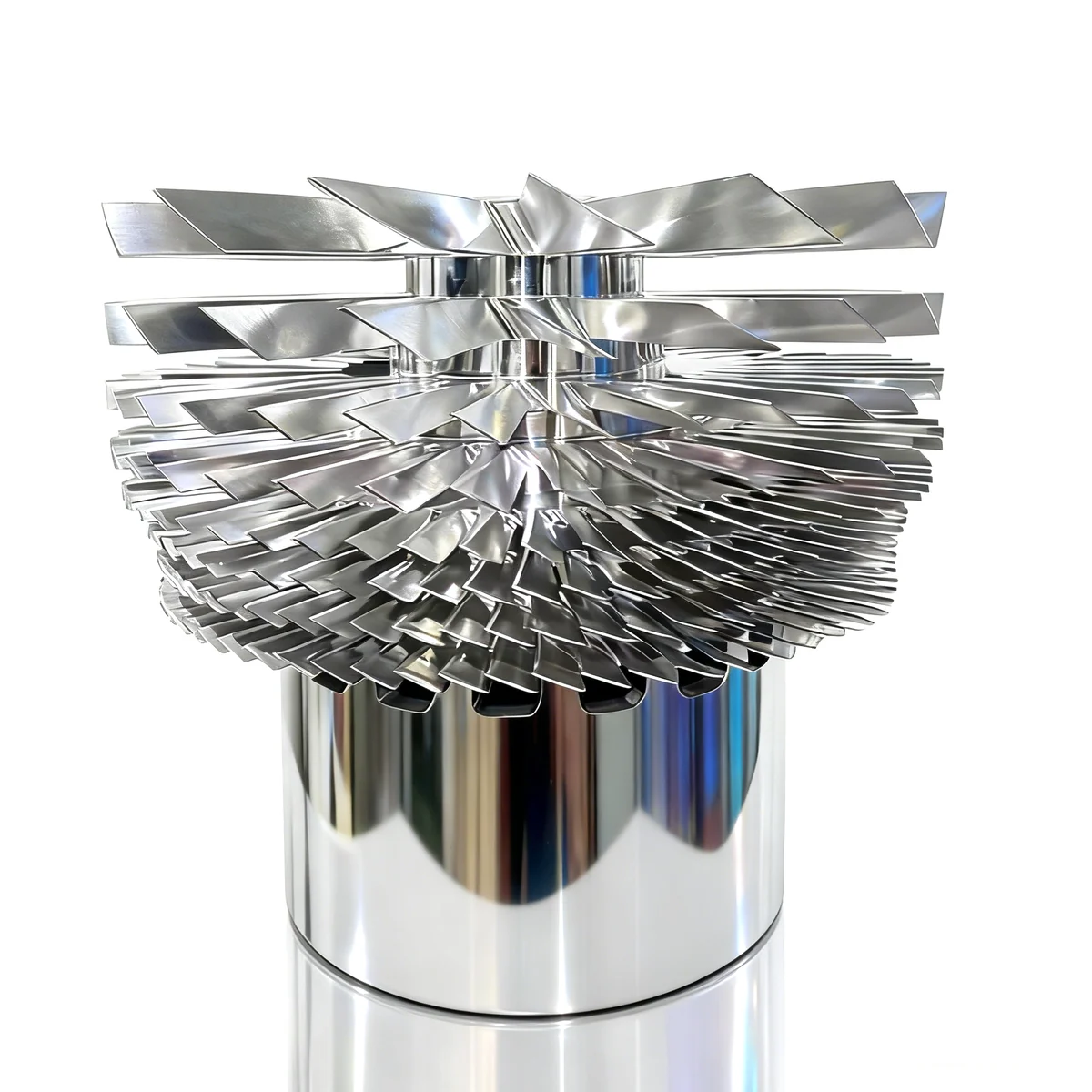
Treat the supplied image as a visual reference for discussing multiple blade rows and a central body. Do not use the image to approve a material, dimension, manufacturing route or use in an operating pump. Request the controlled product definition and the customer's acceptance requirements before interpreting any visible feature as a specification.
For an integrally bladed rotor inquiry, ask engineering to confirm which features belong to the single-piece definition and which belong to a separate assembly. Mark the ordered item on the model. Do not assume that an externally similar rotor can follow the same process plan or use the same inspection setup.
Tool access before toolpath detail
Sandvik Coromant's profile-milling guidance separates roughing, semi-finishing and finishing, and discusses multi-axis methods for complex surfaces. It also identifies long tool overhang as a source of vibration difficulty in deep profiles. These general principles inform a rotor review; they are not a ready-made program for a particular part. [2]
Ask the manufacturing reviewer to demonstrate access to blade roots, spaces between rows and transitions into the hub using the intended cutter and holder. Include the workholding in that discussion, not only the cutter tip. Request a list of features that need a different setup, tool or approach, and resolve those exceptions before releasing the route.
Do not accept the phrase '5-axis CNC machining' as a complete explanation. Ask which surfaces require changing tool orientation, which can be approached with indexed positioning, and where the proposed sequence changes. Have the responsible programmer explain the access strategy against the actual model rather than inferring it from a machine brochure.
Support the blade through the machining sequence
Sandvik Coromant treats thin-wall milling strategy as dependent on wall proportions and the stability of both the cutter and the workpiece. Its examples include staged removal, alternating sides and retaining material for later finishing. Apply these as discussion points, not universal instructions for every rotor. [3]
Ask for the sequence at the stage when the blade has the least remaining support. Which surfaces are finished first? Where can the fixture contact the component? How will the team check a feature after releasing the fixture? Record the answers against the drawing features so that process review and inspection review use the same references.
For an aluminum rotor enquiry, provide the specified material designation and condition rather than selecting an alloy from the photograph. Ask the supplier to identify any proposed material substitution before quotation acceptance. Keep changes to stock, processing or finishing subject to the customer's engineering approval, with the approved choice recorded for repeat orders.
Define surface and edge acceptance before finishing
Sandvik Coromant links the surface generated in profile milling to tool geometry, engagement and toolpath choices. Its guidance also calls for attention to tool setup and workpiece clamping. A finishing discussion should therefore address the intended method as well as the requested surface. [2]
Ask the design owner to identify the surfaces that need measured texture, the blade edges that need a defined condition and any areas where hand finishing is restricted. Request a proposed verification method for each. Do not substitute a glossy photograph or a general 'polished' description for the drawing's acceptance criteria.
If the manufacturing reviewer proposes changing a root transition, an edge treatment or a finishing operation, request the reason and the affected features in writing. Keep the proposed change separate from the released drawing until approved. Where access prevents the preferred measurement method, resolve an alternative with the customer before cutting the part.
Manufacturing review matrix
Use this original buyer-review matrix to turn a technical conversation into a documented handoff. Assign an owner to each open decision and retain the accepted version with the purchase order. The requested evidence should be proportionate to the drawing and application, not copied indiscriminately from another job.
| Review area | Question to resolve | Evidence to agree |
|---|---|---|
| Tool access | How will the cutter and holder reach the root and inter-row spaces? | Annotated model or process-review record |
| Blade support | At which operation will support be most limited? | Workholding and machining-sequence review |
| Surface and edges | Which features need a defined finish or edge condition? | Drawing-linked acceptance and checking method |
| Dimensional inspection | How will measured features map to the released drawing? | Feature-indexed inspection plan and report scope |
| Balancing | Which component or assembly configuration is included? | Written balancing scope agreed separately |
| Release | Who accepts open deviations and authorizes shipment? | Customer approval record and release checklist |
Keep component acceptance separate from pump qualification
Keep dimensional inspection, balancing and application approval as separate decisions. Ask for the scope and responsible party for each, and do not treat a dimensional report as permission to install the component in an operating pump. Refer the operating decision to the customer's responsible technical authority. This article does not prescribe a balancing procedure or operating limit.
For a useful next conversation, send the drawing revision, model, material specification, quantity and the evidence you need with delivery. Highlight unresolved access or edge questions instead of hiding them inside a general request for 'best quality.' Ask for a project-specific review before comparing quoted routes.
Inspection scope and documentation are defined during quotation according to drawing requirements and application needs.
Frequently asked questions
Does five-axis machining alone establish acceptance?
No. Request the proposed route, the agreed checking methods and the records tied to the released drawing. Keep the decision to accept the manufactured component separate from approval for the operating application.
Can a rotor photograph replace a drawing for quotation?
Use a photograph for visual context, then provide a controlled drawing and model for technical review. Ask for unresolved assumptions to be listed explicitly rather than allowing the image to become the product definition.
What should be agreed before a repeat order?
Confirm the drawing revision, material definition, approved process changes and inspection scope. Identify any change from the previous order and request written acceptance before carrying it into the next batch.
Related review paths
More from Blog
References
- How is vacuum actually generated? – Part 3 — Fraunhofer IST. Accessed 2026-09-22T14:48:00.000Z.
- What is profile milling? — Sandvik Coromant. Accessed 2026-09-22T14:48:00.000Z.
- Shoulder milling: thin deflecting walls — Sandvik Coromant. Accessed 2026-09-22T14:48:00.000Z.