
Technical insight
Vacuum Pressure Rise vs. Helium Leak Testing: Which Evidence Do You Need?
Specify a pressure rise screen to track how the isolated volume behaves. When the order calls for a leak location or a total helium leak rate, request the appropriate tracer test on the agreed boundary. Put each result on its own acceptance line.
By Geetai Precision
- Published
- Updated
What the two methods tell you
For a pressure rise test, the test volume is evacuated and then isolated from the pump while pressure is recorded over time. Gas entering through a leak and gas released from internal surfaces can both increase the recorded pressure.
Under stable conditions and with the isolated volume known, multiplying that volume by the observed pressure rise per unit time estimates the apparent gas throughput. It does not identify the gas or its path. Repeated runs after more pumping can help separate a changing internal gas load from a persistent contribution, but a trace alone does not locate the source.
Local helium spraying on the exterior of an evacuated test piece can help locate a path where tracer enters. An integral helium test can instead expose the agreed boundary to tracer and measure a combined signal for that boundary.
Test selection for a housing purchase order
| Acceptance question | Evidence to request | What to keep separate |
|---|---|---|
| Can the isolated volume hold vacuum over the specified interval? | Pressure versus time with the initial pressure, interval, gauge location and enclosed volume identified. | A single endpoint without conditioning or isolation details. |
| Which joint or weld segment responds to helium? | A local tracer check with a location map and response by zone. | A summed leakage requirement for the complete assembly. |
| Does the entire agreed boundary meet a specified helium leak rate? | Tracer exposure method, detector checks and a measured value tied to that assembly. | A quick spray at selected points or an unconverted pressure slope. |
| Is the leak in the fixture or in the housing? | An agreed fixture or blank check, followed by a repeat check with the same connection and closure scheme where practical. | A disposition made before separating test hardware from the supplied part. |
From test sketch to release decision
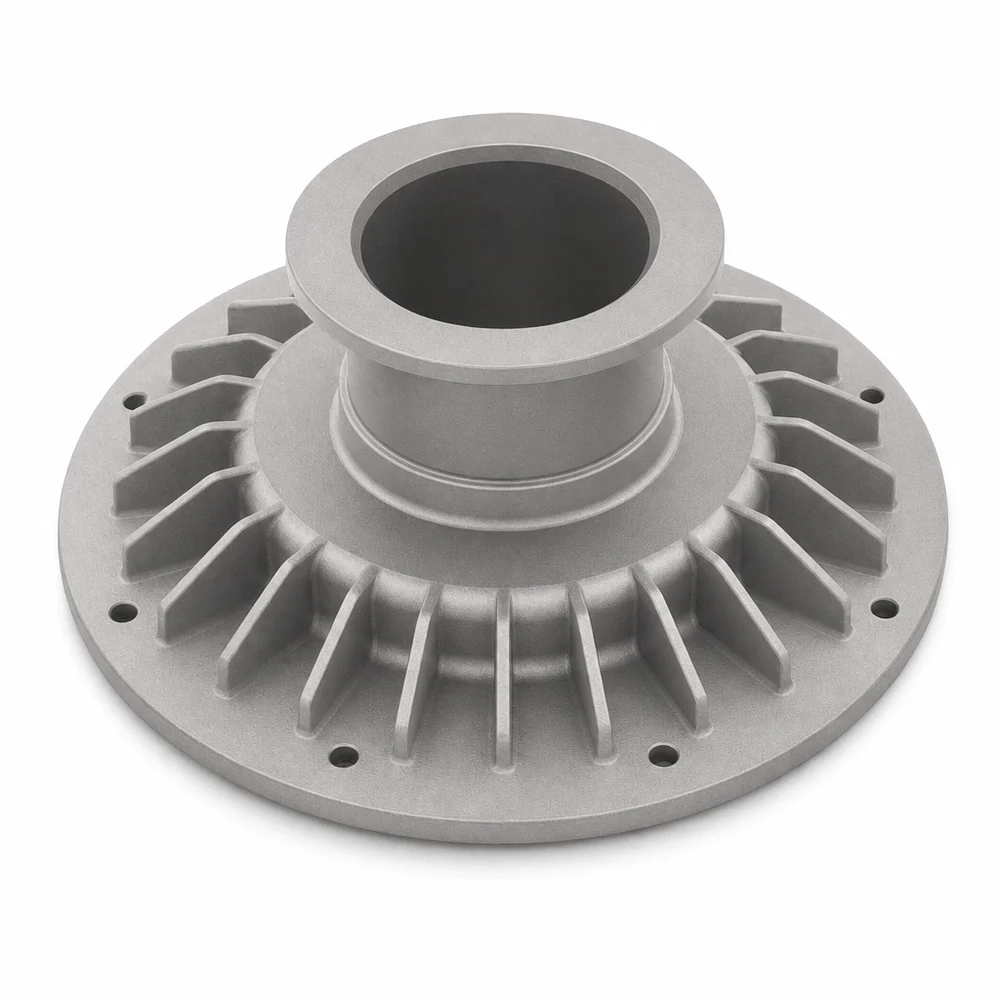
Start with a marked boundary sketch. For a ribbed housing with several ports, list the temporary caps, seals, gauge connection and isolation valve. Identify which joints belong to the supplied part and which belong to the test fixture. If the order calls for a bare housing, do not describe a result from different production seals as assembly acceptance.
Write the pressure rise conditions and the tracer conditions separately. Define the preparation state, initial condition, timing and units for the first; define the tracer exposure, reference check, coverage and reporting method for the second. Agree what happens if a fixture check fails or the signal cannot be interpreted. Preserve both the original record and any approved retest.
For example, a stable pressure rise screen does not resolve a helium response at a port weld. Hold the applicable release line, check the closure and fixture contribution, and use the approved tracer method to decide whether further local investigation or an integral retest is necessary. Keep any operating-system qualification outside a component release unless the order expressly includes it.
For drawing review, include the proposed closure sketch, separate acceptance criteria and required report fields with the component inquiry.
Frequently asked questions
Can I convert any pressure rise slope into a helium leak rate?
Do not transfer a slope directly to a helium criterion. Even with known volume, the result can include gas released within the test volume. Ask for the approved method and gas-specific evidence for the requirement you need to close.
Does a clean local spray check release the whole housing?
Only use it for the coverage and criterion actually approved for that check. If acceptance requires an integral result, keep that as a separate open item.
Related review paths
More from Blog
References
- Pressure rise and drop tests — Leybold. Accessed 2026-11-17T01:28:11.849Z.
- Basics of vacuum leak detection — Leybold. Accessed 2026-11-17T01:27:59.589Z.
- Vacuum laboratory: helium leak detection and outgassing — ESS Bilbao. Accessed 2026-11-17T01:29:05.738Z.