Technical insight
CMM Part Temperature: Evidence Before Dimensional Acceptance
Before ordering CMM inspection, ask how the provider will establish the part’s thermal condition when the reported features are measured. Agree the dimensional reference condition, the evidence used to release the part for measurement, and the records linking that decision to the inspection run. A room reading or a scheduled waiting period should not replace the task-specific explanation.
By Geetai Precision
- Published
- Updated
The condition behind the dimensional report
An impeller drawing and an inspection quotation may identify the same features yet leave a practical question unresolved: what establishes that the component was ready for measurement after transport, handling or preceding work? Ask for that decision before ordering, rather than reconstructing it from the final report.
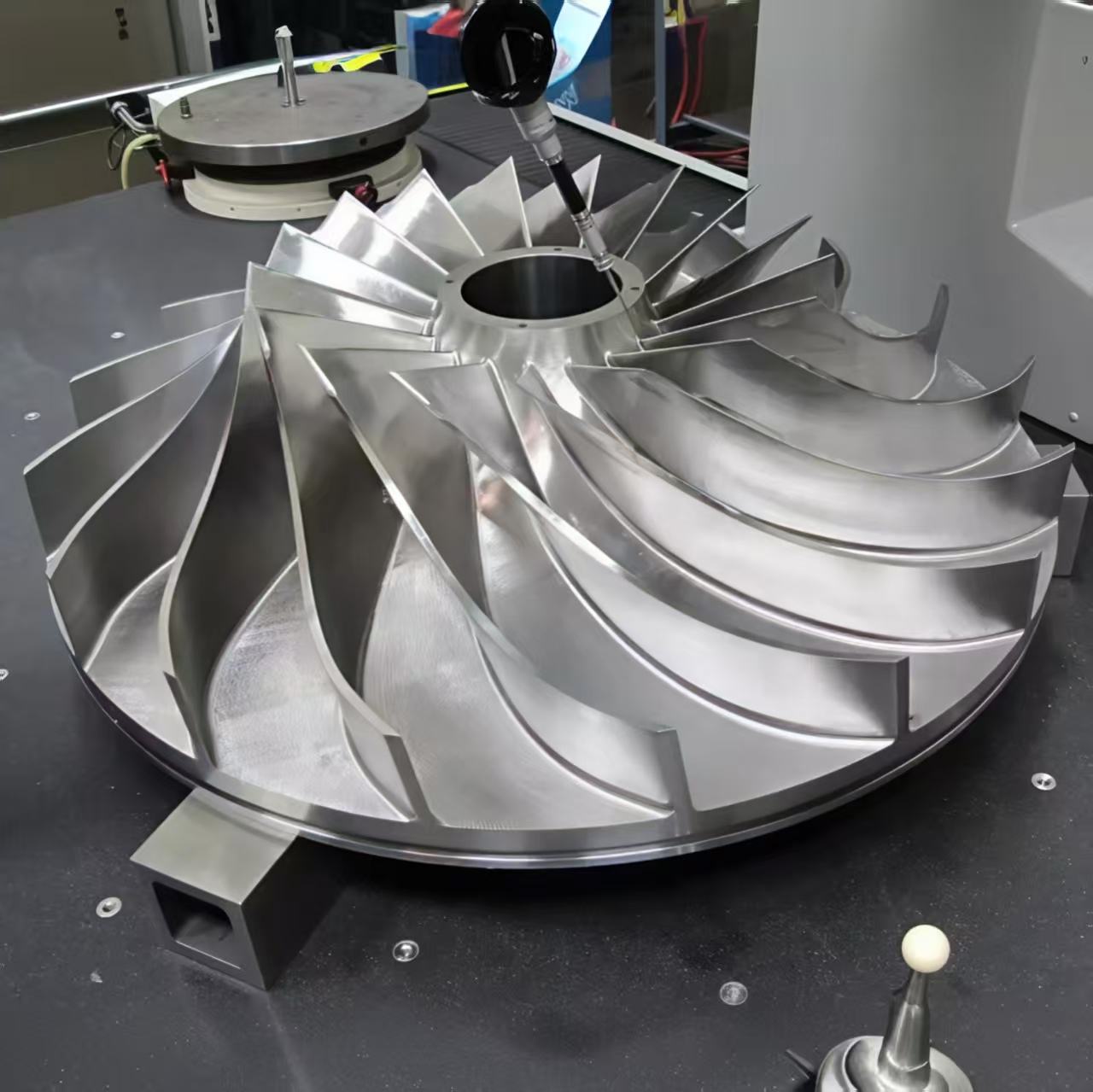
The supplied photograph places a curved-blade component and probe in an inspection context. It supplies no temperature readings, stabilization history or approval of a particular measurement run. Use it to frame a question about the missing records; do not infer equipment ownership or completed delivery from the scene.
NPL’s GPG130 advises thermal stabilization before measurement, ideally in the measuring environment. Its thermal-equilibrium section describes monitoring part temperature or repeating dimensional measurements to establish stabilization time. This is guidance for developing a task-specific approach, not a universal waiting period. [1]
Reference temperature and actual part condition
NIST’s discussion of the 2016 revision of ISO 1 distinguishes the reference temperature from the standard reference temperature of 20 °C. It explains that explicitly specified nonstandard reference temperatures can apply to different properties of a workpiece. [2]
Separate the condition defining a drawing’s dimensions from the conditions observed during measurement. Ask the technical owner to identify the applicable drawing or specification and the provider to explain how the report relates to it. Treat a reference value as a definition to resolve, not proof that the physical part reached that state.
If the proposal uses temperature correction, ask which part-temperature observations, material expansion data and software settings it requires, and who checks those inputs. Keep their approval separate from the equilibration decision. NPL discusses software correction alongside stabilization; a correction label alone does not describe the actual preparation. [1]
Thermal-condition purchasing worksheet
| Review item | Evidence to request | Decision checkpoint |
|---|---|---|
| Drawing reference condition | Identify the controlled specification and any feature-specific reference condition. | Hold clarification if the quotation assumes a different basis without technical approval. |
| Part readiness | Request the approved equilibration method and the observations supporting its release decision. | Ask for more evidence when only room temperature or elapsed time is supplied. |
| Changes before or during the run | Agree which handling, relocation or environmental changes trigger a fresh review. | Record the disposition and affected features before relying on the original release. |
| Correction inputs | Identify applicable material data, part-temperature inputs and the approved correction setup. | Resolve missing or inconsistent inputs with the metrology owner before acceptance. |
| Inspection record linkage | Link the part identity, preparation record and measurement run in the agreed handoff. | Request the missing linkage when an environmental log cannot be tied to the reported item. |
From quotation to inspection release
At quotation review, supply the drawing revision, part configuration, material identification and features requiring dimensional records. Ask the provider to state whether preparation, condition records and any correction review are included. Resolve exclusions before approving the inspection order.
Before the run, request the approved method reference and the evidence used to decide readiness. Have the metrology team explain why its observations represent the actual item and measurement task. If its plan relies on repeated dimensions, agree which observations and decision criteria will be retained.
During execution, retain the preparation-to-run link and record events that the approved plan treats as relevant changes. Do not automatically carry a release decision across a different part configuration, relocation or interruption. Ask the technical owner whether the evidence remains applicable or whether further checks are needed.
At report review, check that the stated reference basis, applicable correction information and preparation record refer to the delivered item and reported run. A general room log without that connection leaves the purchasing question unanswered. Resolve gaps through the agreed review route before treating the documentation as complete.
A bounded clarification example
Consider a hypothetical impeller inspection quote that says only “allow to stabilize before CMM.” Ask the provider to replace that open instruction with a referenced method, a readiness decision and an agreed record. If it offers an elapsed-time rule, request the evidence supporting that rule for the proposed item and conditions; do not select an arbitrary number of hours.
This guide does not establish laboratory conditions, an acceptable thermal gradient, a universal soak duration or acceptance of a dimension. It also does not replace probe qualification, drawing alignment, feature coverage or the agreed conformity decision. Those reviews remain necessary for their respective questions.
Geetai coordinates drawing-led manufacturing through long-term partners without presenting partner facilities as Geetai-owned.
Inspection scope and documentation are defined during quotation according to drawing requirements and application needs.
For a drawing-led inquiry, include the controlled drawing, material identification, inspection features and any existing thermal-condition requirements. Ask the quotation to identify the preparation and reporting activities offered, open technical questions and the person responsible for approving the proposed approach.
Frequently asked questions
A suitable universal stabilization time?
Do not insert a generic duration into the order. Request a task-specific method and its supporting observations, with the actual readiness criteria selected by the responsible metrology team.
A room-temperature log as sufficient evidence?
Ask how that log connects to the item and measurement run, and what evidence supports the part-readiness decision. A room reading alone does not document the proposed equilibration method or the part’s recorded history.
Related review paths
More from Blog
References
- CMM task-specific measurement uncertainties, GPG130 — thermal equilibrium, printed page 49 — National Physical Laboratory. Accessed 2026-11-04T01:45:43.596Z.
- The 2016 revision of ISO 1 — standard reference temperature — National Institute of Standards and Technology. Accessed 2026-11-04T01:45:43.596Z.